Greater Dickson Gas Authority, Dickson TN | CNG Home
CNG Home
A Proud Canopy Crew
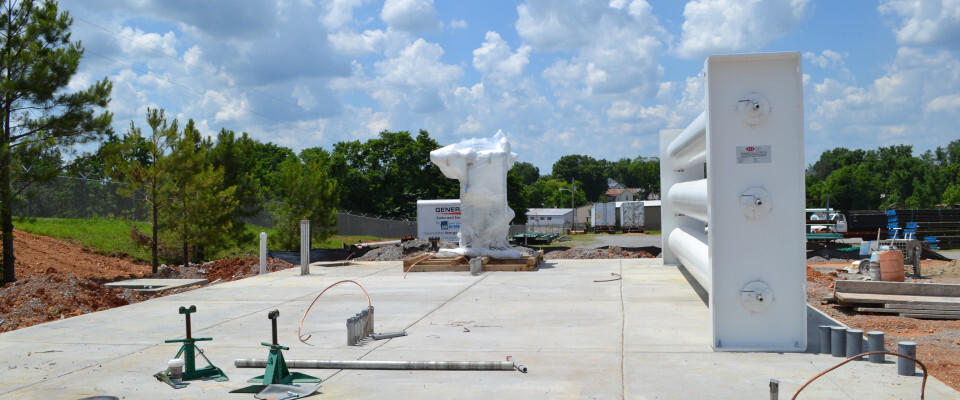
Greater Dickson Gas Authority is proud to announce its NEW CNG station!
Compressed Natural Gas is the newest way to harness the power of natural gas to fuel your own car. By doing so, you have unlocked a new source of cleaner, cheaper, and safer energy!
Curious about what CNG is? Click here to find out!






Why CNG?
CNG is an abbreviation for Compressed Natural Gas. Compressed Natural Gas is exactly the same as the fuel that is delivered to our customer’s homes but is simply compressed so that we can store more of it in one place. This allows us to use CNG to fuel generators, tractor trailers, and even your own automobile! CNG is a great alternative fuel because it is cleaner, cheaper, and greener than gasoline.
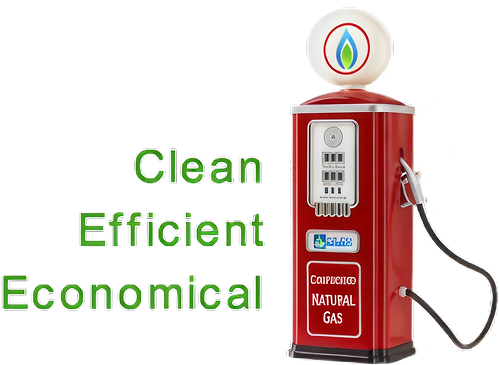
Cleaner
Natural gas consists primarily of methane, a molecule with the chemical formula CH4. Due to methane having only one carbon atom in its chemical structure (CH4), it releases approximately one-eighth the carbon atom emissions that gasoline (which is largely made up of octane, C8H18) releases. Even against a renewable source of energy, ethanol (C2H6O), natural gas still emits half of the carbon atoms that ethanol emits.
Cheaper
As the United States continues to import oil, the price of gasoline will continue to rise. Thanks to the increased production of natural gas caused by the fracking of shale, among other techniques, the price of natural gas is at a low. According to AAA, as of June 2015, the national average for the price of gasoline was $2.75.
When the Greater Dickson Gas Authority CNG station comes online, we will be selling CNG to any properly equipped vehicle, at the gallon of gas equivalent (gge) of less than $2.00!

Greener
CNG is not only cleaner, but is also greener and better for the environment. In addition to reduced carbon emissions, CNG powered vehicles have great emission reductions such as:
- Carbon monoxide emission reduced up to 75%
- Nitrogen oxide emission reduced by approximately 50%
- Particle matter emissions reduction of up to 95%
What does CNG mean?
CNG is an abbreviation of Compressed Natural Gas. Compressed Natural Gas is the same fuel that is pumped to your home and powers your water heater, stove, and grill.
What is Compressed Natural Gas used for?
How does Compressed Natural Gas affect my car engine?
Natural gas is a cleaner burning fuel than gasoline. This actually has a beneficial effect on multiple parts of the automobile. Not only will it extend the life of the engine, but it will also extend the life of your oil change and fuel lines!
How does Compressed Natural Gas affect my horsepower?
Tests have shown that the horsepower of a CNG powered vehicle is slightly less than that of a gasoline powered vehicle.
How will Compressed Natural Gas affect my mileage?
There should be no change in your mileage and even possibly a small increase in your mileage! See CNG United for more info on how mileage is affected.
Is Compressed Natural Gas safe?
Yes, CNG is very safe. Almost all gasoline tanks on everyday automobiles are made out of thin sheet metal. CNG tanks are made of steel and designed to withstand high speed crashes without being damaged.
How big are Compressed Natural Gas tanks?
When converting your vehicle to CNG, there is a tank designed to fit your needs. Sizes range from the 2 gge (Gallon of Gasoline Equivalent) to 53 gge capacity tanks. CNG United covers these sizes and types of tanks in greater detail.
How much is Compressed Natural Gas?
On average, nationally, the price of CNG is $2.01; this is compared to the national averages of gasoline and diesel respectively, which are $3.39 and $3.89, according to CNGPrices.com. In the state of Tennessee, the average is $2.01. We anticipate being able to sell CNG at the sub-$2 level.
How much does it cost to convert my vehicle to use Compressed Natural Gas?
Conversions for Compressed Natural Gas vehicles can cost as little as $1,000 dollars to as much as $13,000, depending on the source, the type of conversion (dedicated or bifuel), and state issued refunds. Although this is a wide range, most conversions on consumer vehicles fall in the $5,000 to $8,000 price range. As more and more companies begin to drop, the price to convert a car will drop as well.
Are there any incentives to convert my vehicle to Compressed Natural Gas?
There are currently no federal incentives to convert to CNG for most average consumers. The state of Tennessee currently only lets CNG vehicles drive in the High-Occupancy Vehicle lanes, regardless of the number of occupants in the car. Sky CNG has a list that covers the incentives offered by various states, here. There is another (more detailed list) available through NGVAmerica.com, here.
Is Compressed Natural Gas really cleaner?
Why should I use Compressed Natural Gas?
CNG is cleaner, cheaper, and greener than other fossil fuels. As the United Stats begins exploring new energy options, natural gas is poised to be the new fuel of choice, bringing with it a slew of rebates and incentives for consumers to adopt it. See our Why Use CNG? page for a more in-depth look at why CNG should be your fuel of choice.
Resources
This page contains many useful resources on the science of CNG, the effects of CNG on your car and the environment, as well as information on converting your own vehicle to CNG.
- CNG
- Converting Your Vehicle
Converting Your Vehicle
If you are serious in converting a fleet to CNG, some companies specialize in it:
View DetailsConverting Your Vehicle
Many companies and governments are converting entire fleets to CNG
View DetailsGet in Touch
If you would like more information about our Natural Gas services, please complete the information below and submit to us so we can contact you. Thank you!